
Welcome to the iPrepBuddy Monthly Newsletter!
Stay informed with the latest updates on our platform and the newest advancements in ophthalmology. This newsletter aims to keep you prepared for your upcoming exams.
by Dr Chloe Walugembe on 01/04/2026
🎉Firstly, a huge congratulations to everyone who made it through this year's ophthalmology application process - we know how tough it can be 🎉.
Congratulations for all of those who received a training number and for those that didn't please feel free to get in touch with us if you have any questions and would like some guidance on the next steps.
Used our ST1 modules? We'd love to hear how your application went and any feedback on how we can improve — please do get in touch
Clinical Insight: Essential iris Atrophy
~ 1 of 3 clinical variants of iridocorneal endothelial (ICE) syndrome
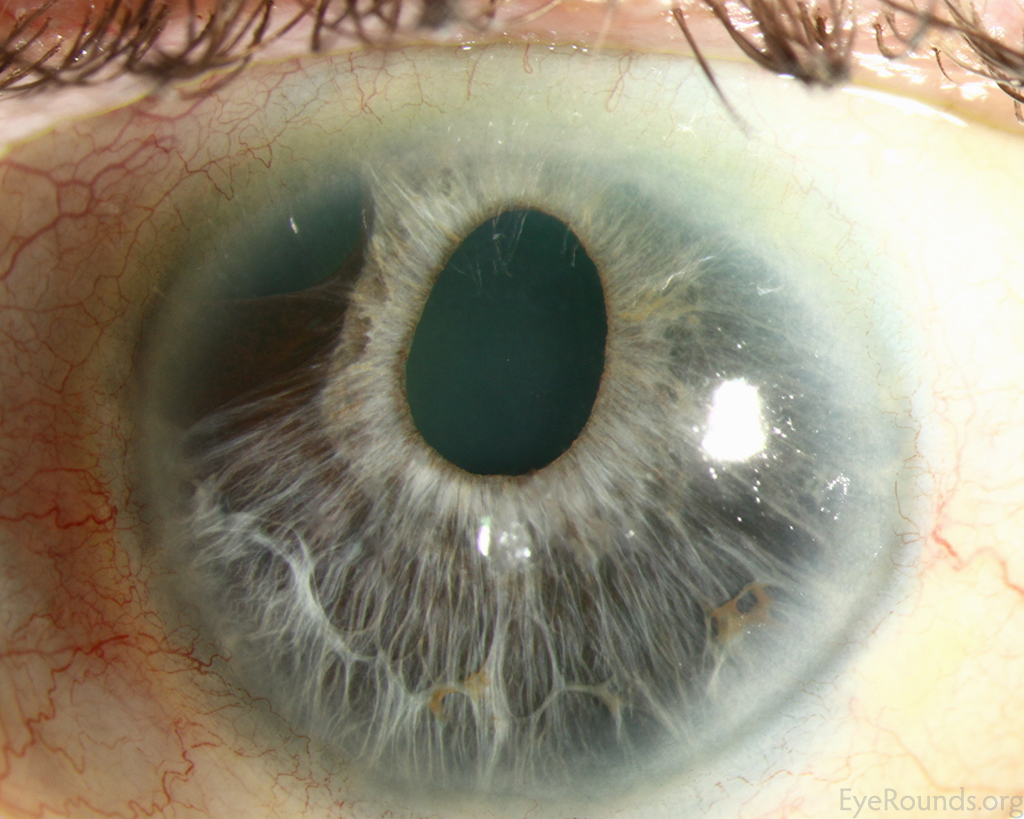
Figure 1: shows corectopia with a superotemporal iris melt hole in a patient with essential iris atrophy. Image courtesy of EyeRounds (1).
ICE syndrome is a rare, usually unilateral eye disorder where corneal cells migrate to the iris, causing corneal swelling, iris distortion, and secondary angle-closure glaucoma. Most common in middle aged women.
Cause: The exact cause is unknown, though viral infection with HSV or EBV is the leading theory (2).
ICE syndrome has 3 overlapping clinical variants:
Chandler syndrome - most common type (50%) greater degree of corneal pathology
Essential/progressive iris atrophy (Figure 1)- an abnormally proliferating corneal endothelium grows across the trabecular meshwork and iris to form broad peripheral anterior synechiae (PAS), ectropion uveae, and iris stretch and melt holes
Cogan-Reese syndrome - distinguished by the presence of multiple pigmented pedunculated nodules on the anterior iris surface.
Platform Updates
The ST1 module now features 40 scenarios.
The New FRCOphth Part 2 Oral scenarios are now up
Please don’t hesitate to reach out if you experience any difficulties with the platform or have feedback to share- we are here to help!
FRCOphth Candidates
1. Number of individuals with glaucoma set to rise by 60% by 2060 .
a. A recent study released in March 2026 by Moorfields and UCL using the most recent consensus data estimates a 60% rise in glaucoma cases. Currently there is 1.02million people living with glaucoma and is set to rise to over 1.61million by 2060. This anticipated 60% rise in cases, despite only a 28% increase in the population aged ≥40 years, reflects the UK’s demographic ageing and the growth of higher-risk ethnic populations (3).
2. Recent changes to the English Diabetic Eye Screening Programme
A 2026 review outlines the 3 recent updates to the English Diabetic Eye Screening Programme (DESP), each aimed at managing growing demand and ensuring long-term sustainability:
a. 2-yearly screening for low-risk groups — certain patients are now eligible for biennial rather than annual screening, based on their graded risk status.
b. R2 (pre-proliferative retinopathy) grade split into high and low risk groups - the previous R2 category has been subdivided to reduce unnecessary referrals to hospitals.
c. OCT introduction into DESP for all maculopathy cases — this should reduce the volume of maculopathy cases requiring HES referral by enabling more nuanced decision-making at screening level (4).
3. Retinitis pigmentosa — gene therapy approaching regulatory submission
MCO-010 (Nanoscope Therapeutics) is a mutation-independent optogenetic therapy for RP, currently under FDA review following a rolling BLA submission — the first gene-agnostic therapy of its kind to reach this stage. It uses a vector to deliver opsins to bipolar cells to restore light sensitivity regardless of the underlying mutation. The Phase 2b RESTORE trial demonstrated significant BCVA improvements at 52 weeks, sustained at three years, with a reassuring safety profile through five years of follow-up (5,6,7).
Upcoming Conferences
Moorfields International refractive symposium – 18th April | London
British Oculoplastic Surgery society conference – 17th – 19th June | Sheffield
RCOphth Annual Congress 2026 — 18th –21st May | Manchester
Abstract deadline: Passed in October 2025
British & Irish Paediatric Ophthalmology Conference — 30th Sep–2nd Oct | Liverpool
Abstract deadline: 24 April
United Kingdom & Ireland Society of Cataract &Refractive Surgeons – 18th- 20th Nov | London
Abstract deadline: to be confirmed